The Second Labour
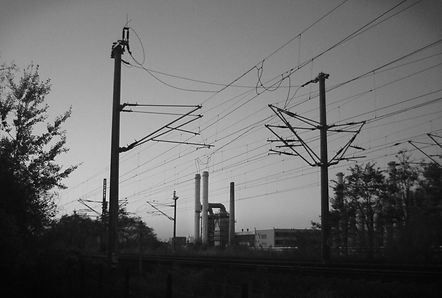
The Second Labour is an ongoing photo project that deals with themes of industrialism and material contrast throughout the land, done so through the retelling of the famous Greek mythological story, The Second labour of Hercules. This story sees Hercules sent to slay The Hydra ordered so by Eurystheus, the king of the Tiryns as part of his 12 Labours to amend the sin of killing his wife and children whilst under a state of madness induced by Hera. Once he has reached the swamp near Lake Lerna, where the Hydra dwells, it shows itself spewing poisonous fumes. He shot flaming arrows into the Hydra's lair, a deep cave from which it emerged only to terrorize the nearby villages. With each successful attempt to decapitate The Hydras heads two more would grow in their place. As long as it retained at least one head it was invulnerable to death. Heracles then called on his nephew Iolaus for help, from which he suggested cauterising the freshly severed heads using a firebrand of which he wielded. The Hydra's final immortal head was cut off with a golden sword given to Heracles by Athena. Heracles placed the head, which was still alive, under a giant rock on the sacred way between Lerna and Elaius. Finally, Hercules dipped his arrows in the Hydra's poisonous blood signalling the completion of his second labour.
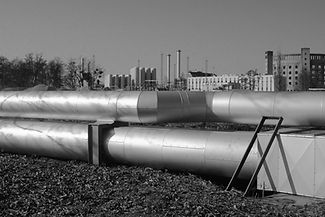
My modern rendition follows a recurring metal pipe structure, The Hydra, I see whilst I walk throughout my current home city of Dresden. The pipes, in reality, are a part of the district heating for the city. This system can be traced all the way back to 1890s where king Albert found it to be too cold at the Catholic court church during mass. It was Italian architect Gaetano Chiaveri who was tasked with finding a solution. A stove was out of the question as its chimney would disturb the beauty of the church and its spire. Chiaveri then looked across the pond for inspiration where he learned of homes in New York using steam lines for their heating. This system, instead of simply heating homes, had a much larger task. It had to heat grand buildings such as the Hofkirche, Schloss, Zwinger, Hoftheater, Albertinum, Kunstakademie and Ständehaus. An immense task that was eventually achieved by building a dedicated heating plant right amongst these glorious buildings. But this building was not to be an eyesore, it had to match the beauty of its fellow structures. It sat next to the extravagant Theaterplatz where the design of the building cleverly employed an ornamental spire in which the chimney hid, not disturbing the beauty of the city. It was a great success but only served as the main heating plant in Dresden for a short period until it was found that hot water was a more economical alternative to steam. The spire of the plant was removed in the 1930s and the building itself found its end in the bombing of Dresden during the 2nd world war. In its entirety the creation of the Dresden district heating system was an immense achievement so much so that the original system where the heating plant originally stood is still used today to heat that portion of the city.
This body of work amounts to a twisting of two histories to create a new narrative, a tale of great strength and cunningness comes together with a story of ingenuity and inventiveness where it now finds itself in my mind where it becomes a commentary on industrialism and the contrasts between materiality found in both the man made and the natural world.